LogDx-CI Leaderboard
← Home · Citation · Technical report
All scores are case-count-weighted macro diagnosis_score_v1_1
aggregated across the 35-case v1.0 corpus (3 splits: dev,
holdout, stress). The score formula (a calibrated linear
combination of category accuracy, signal-mention recall, file/test
recall, must-mention coverage, valid-evidence-quote rate, with
forbidden-claim and confident-error penalties) is documented in
docs/evaluation/diagnosis_eval_v1.md.
Overall (35-case corpus, 3 debugger families)
Sorted by overall mean across the three debugger families.
confident_error is the v1.1-calibrated rate of confidently-wrong
diagnoses (confidence ≥ 0.70 AND the diagnosis is demonstrably wrong
on multiple fronts) — lower is better. It is the metric closest to
“how often does this method lead an LLM to confidently misdiagnose a
CI failure,” which is the failure mode raised in
rtk-ai/rtk#1599.
| Rank | Method | Haiku 4.5 | Sonnet 4.6 | gpt-5-mini | Overall | confident_error (↓ better) |
total_tokens per case (↓ better) |
|---|---|---|---|---|---|---|---|
| 1 | hybrid-grep-120k-rtk-tail |
0.624 | 0.679 | 0.706 | 0.670 | 0.000 | 19,844 |
| 2 | hybrid-grep-120k-tail |
0.610 | 0.730 | 0.658 | 0.666 | 0.010 | 19,753 |
| 3 | llm-summary-v1-gpt-5-mini(real gpt-5-mini map-reduce summarizer; promoted to headline in v1.2) |
0.654 | 0.686 | 0.652 | 0.664 | 0.010 | 537,638 |
| 4 | grep |
0.578 | 0.684 | 0.655 | 0.639 | 0.000 | 88,355 |
| 5 | llm-summary-v1-haiku(real Haiku 4.5 map-reduce summarizer; promoted to headline in v1.1) |
0.583 | 0.704 | 0.608 | 0.632 | 0.029 | 1,681,520 |
| 6 | tail-200 |
0.595 | 0.624 | 0.623 | 0.614 | 0.019 | 6,108 |
| 7 | hybrid-grep-4k-rtk-err-cat(earlier 4k-threshold hybrid; replaced — see report) |
0.552 | 0.597 | 0.571 | 0.573 | 0.029 | 19,892 |
| 8 | rtk-err-cat |
0.455 | 0.488 | 0.467 | 0.470 | 0.029 | 19,850 |
| 9 | raw |
0.324 | 0.368 | 0.367 | 0.353 | 0.000 | 275,248 |
| 10 | rtk-read |
0.329 | 0.369 | 0.349 | 0.349 | 0.010 | 274,289 |
| 11 | rtk-log |
0.238 | 0.262 | 0.249 | 0.249 | 0.133 | 810 |
Footnote on
llm-summary-v1-haiku: three of the 35 cases (nodejs-test-debugger-exec-timeout-v2-001, pytest-sklearn-stress-001, pytest-sklearn-stress-002) usedchunk_lines=100instead of the default 500 because they contained 500-line windows that exceeded Haiku’s effective input window after Claude-Code session overhead. Same map-reduce algorithm, same model, same temperature — only the map-stage granularity differs and is recorded in per-casemetadata.chunk_lines. The other 32 cases usedchunk_lines=500.
The legacy llm-summary-v1-mock is no longer in the headline table.
See the appendix for its retained
numbers and rationale.
Two layers of finding:
-
Safety (confident_error) — the top-3 methods produce zero or near-zero confidently-wrong diagnoses.
rtk-logand the legacyllm-summary-v1-mockmislead a confident LLM on ~13% of cases (rtk-ai/rtk#1599). The real Haiku summarizer (llm-summary-v1-haiku, row 4) cuts confident-error to 2.9% — an order-of-magnitude safer than the mock that previously stood in for it. -
Cost (total_tokens) —
grep(rank 3) uses 4.5× more tokens per case than the top-2 hybrids while scoring lower. The hybrids dominate grep on both axes.llm-summary-v1-haikuis the most expensive method on the leaderboard at 1.68M tokens/case — the real summarizer is ~4× more expensive than the mock estimated (1.68M vs 432k), because the mock didn’t model the cached-prefix overhead of nested Claude calls per chunk. See the cost-quality Pareto plot below for the full picture.
Cost-quality Pareto frontier
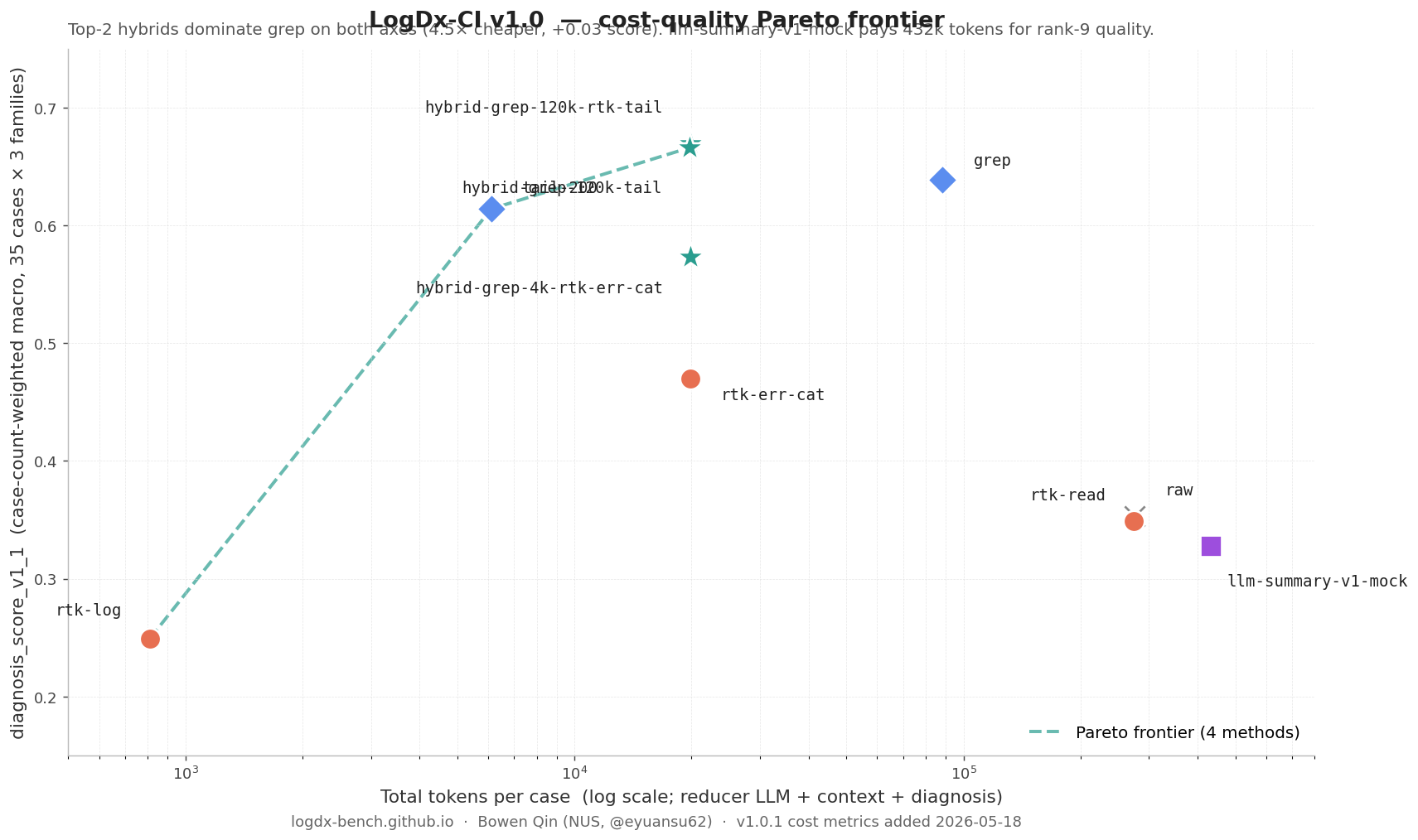
x-axis is total LLM tokens consumed per case on a log scale
(reducer-internal LLM calls + context delivered to the diagnoser +
diagnoser output). y-axis is the published diagnosis_score_v1_1.
The frontier (4 methods, dashed line) is:
| Pareto-optimal method | total_tokens / case | diagnosis_score_v1_1 |
|---|---|---|
rtk-log |
810 | 0.249 |
tail-200 |
6,108 | 0.614 |
hybrid-grep-120k-tail |
19,753 | 0.666 |
hybrid-grep-120k-rtk-tail |
19,844 | 0.670 |
Every other method is dominated — some other method achieves at least as good a score for fewer tokens, or strictly more score for the same tokens. Most notable dominations:
grepis dominated byhybrid-grep-120k-tail— same score ballpark (0.639 vs 0.666) at 4.5× fewer tokens (88,355 vs 19,753). If you’re usinggreptoday, the 120k-tail hybrid is a pure upgrade on both axes.rtk-err-catis dominated byhybrid-grep-120k-tail— similar token cost, but the hybrid scores +0.20 higher.-
llm-summary-v1-gpt-5-mini(rank 3 single-shot, rank 1 agent-loop) is the v1.2 result that changed the cost-quality story. At 0.18 USD/case it’s 6× cheaper thangrepand 10× cheaper than the haiku-summary equivalent ($1.76). It’s also the cheapest method in agent-loop tokens (10.8k agent-side; reducer adds 512k) and uses the LOWEST tool-call count of any method (0.37/case — half as many astail-200’s 0.69). For agent-loop usage,llm-summary-v1-gpt-5-minidominates the entire frontier. For single-shot single-method rankings, it lands at #3 by raw quality and is still 4× cheaper per case thangrep(#4). See the v1.2 promotion section below for the cross-family finding (gpt-5-mini-summarizer + Haiku-debugger beats Haiku-summarizer + Haiku-debugger — falsifies the self-call- bias hypothesis). llm-summary-v1-haiku(rank 5) is now the more expensive cousin. It scores 0.632 (rank 5 overall) but at 1.68M tokens/case it’s the most expensive method on the leaderboard. The dominant cost is the reducer itself: 1.66M input tokens spread across 12–108 chunked Haiku calls per case (Claude-Code-CLI cached-prefix overhead is significant), producing a ~1.1k-token summary. v1.2’sllm-summary-v1-gpt-5-minishows the LLM-summary class is not inherently expensive — Haiku via the Claude-Code-CLI nested path carries 4× more overhead per case than gpt-5-mini direct, with comparable summary quality.
Cost breakdown (case-count-weighted macro)
| Method | reducer_in (LLM input) |
reducer_out (LLM output) |
context (→ diagnoser) |
diag_out (diagnoser output) |
total |
|---|---|---|---|---|---|
rtk-log |
0 | 0 | 325 | 485 | 810 |
tail-200 |
0 | 0 | 5,569 | 539 | 6,108 |
hybrid-grep-120k-tail |
0 | 0 | 19,219 | 534 | 19,753 |
hybrid-grep-120k-rtk-tail |
0 | 0 | 19,311 | 533 | 19,844 |
rtk-err-cat |
0 | 0 | 19,383 | 467 | 19,850 |
hybrid-grep-4k-rtk-err-cat |
0 | 0 | 19,388 | 504 | 19,892 |
grep |
0 | 0 | 87,862 | 494 | 88,355 |
rtk-read |
0 | 0 | 273,998 | 291 | 274,289 |
raw |
0 | 0 | 274,944 | 304 | 275,248 |
llm-summary-v1-haiku |
1,661,358 | 18,451 | 1,100 | 611 | 1,681,520 |
reducer_in and reducer_out are non-zero only for methods that
internally call an LLM (here, llm-summary-*). For grep/tail/
rtk-*/raw the reducer is a CPU-bound transform with no LLM cost.
Reducer runtime where measured (only available for RTK methods,
which write external_tool.runtime_ms into their manifests):
| Method | reducer_runtime |
|---|---|
rtk-read |
9.9 ms |
rtk-log |
18.7 ms |
rtk-err-cat |
35.4 ms |
grep/tail runtime is unmeasured in v1.0 but is empirically
sub-100ms for every case in the corpus (CPU-bound, single-pass).
USD cost (v1.1.2)
Provider list prices are pinned to a snapshot date in
configs/pricing/snapshot_2026_05_20.json.
Per-case dollar cost is computed by
tools/compute_usd_costs.py
from real per-call API usage on the reducer side (when applicable)
plus eval-manifest macro_context_tokens / macro_diagnosis_tokens
on the diagnoser side.
| Method | Haiku $ | Sonnet $ | gpt-5-mini $ | Avg single-shot $ | Reducer $ | Total $/case |
|---|---|---|---|---|---|---|
rtk-log |
$0.0022 | $0.0083 | $0.0013 | $0.0039 | — | $0.0039 |
tail-200 |
$0.0077 | $0.0246 | $0.0027 | $0.0117 | — | $0.0117 |
rtk-err-cat |
$0.0193 | $0.0681 | $0.0062 | $0.0312 | — | $0.0312 |
hybrid-grep-120k-rtk-tail |
$0.0167 | $0.0704 | $0.0069 | $0.0313 | — | $0.0313 |
hybrid-grep-4k-rtk-err-cat |
$0.0198 | $0.0690 | $0.0062 | $0.0317 | — | $0.0317 |
hybrid-grep-120k-tail |
$0.0163 | $0.0746 | $0.0066 | $0.0325 | — | $0.0325 |
grep |
$0.0859 | $0.2772 | $0.0236 | $0.1289 | — | $0.1289 |
llm-summary-v1-gpt-5-mini |
$0.0044 | $0.0154 | $0.0019 | $0.0072 | $0.1764 | $0.1836 |
rtk-read |
$0.2721 | $0.8354 | $0.0692 | $0.3922 | — | $0.3922 |
raw |
$0.2721 | $0.8355 | $0.0700 | $0.3925 | — | $0.3925 |
llm-summary-v1-haiku |
$0.0034 | $0.0134 | $0.0016 | $0.0061 | $1.7536 | $1.7597 |
Three layers of finding:
- The top-2 hybrids cost ~3¢/case end-to-end across the 3 single-
shot families.
tail-200at 1.2¢ is cheaper but ranks lower on quality. The 3¢ tier is the sweet spot. rawandrtk-readare ~10× more expensive than the hybrids (~39¢/case) because they ship the full log to the diagnoser; the hybrids cap context at 120k tokens. This is the dominant cost axis for any method that doesn’t pre-summarize.llm-summary-v1-haikuis 5× more expensive thanraw($1.76 vs $0.39) because the reducer itself burns ~1.66M Haiku-input tokens per case. The downstream diagnoser cost is tiny ($0.006 for haiku-summary vs $0.39 for raw) — the reducer dominates the total. Whether this is worth it depends on whether you’d otherwise send raw to a more expensive model (Sonnet raw = 83¢/case; haiku-summary + Sonnet diagnoser = 1.77¢ diagnoser side + 1.75 reducer = $1.77 — close).
Caveats
- Snapshot prices, not live. The pinned prices in
snapshot_2026_05_20.jsonmay have drifted from current provider list prices. Re-runtools/compute_usd_costs.py --pricing <new-snapshot>against a fresh snapshot for current numbers. - Diagnoser-side tokens are byte-size estimates (
output_byte_size // 4) from the eval manifests, not provider-reported tokens. Some older diagnosis rows haveusage=None(pre-2026-05-14 F2 shim fix); using estimates ensures every method × family pair is treated identically. The order of magnitude is correct; exact dollar amounts may differ ±15% from a provider-billed re-run. - Reducer-side tokens ARE provider-reported (from
metadata.usage.input_tokens/output_tokensper row). This matters forllm-summary-v1-haikusince the reducer dominates that method’s total; the number above reflects what a direct-API re-run would actually bill. - No agent-loop USD in this section. Agent-loop costs are reported separately in the agent-loop table below; agent_v1 runs via OpenRouter which reports cost directly per call.
- USD column is NOT in the headline overall table. The headline
ranking is still pure quality (
diagnosis_score_v1_1). Use this section to make cost-quality trade-offs, but don’t read “rank by total $/case” as the recommendation —tail-200is cheapest but ranks 5 on quality, andllm-summary-v1-haikuis most expensive but ranks 4 on quality. The cost-quality Pareto plot above visualizes this.
Agent-loop leaderboard (v1.1)
The single-shot leaderboard above tests log → reducer → single LLM
call → answer. Real Claude Code / Codex usage looks different: the
model can call follow-up tools when its initial context is missing
something. v1.1 adds the agent-loop measurement using a new
diagnoser real-agent-v1 (Sonnet 4.6, max 5 turns × 4 deterministic
tools: grep, read_file, tail, view_log_lines operating on the
raw log).
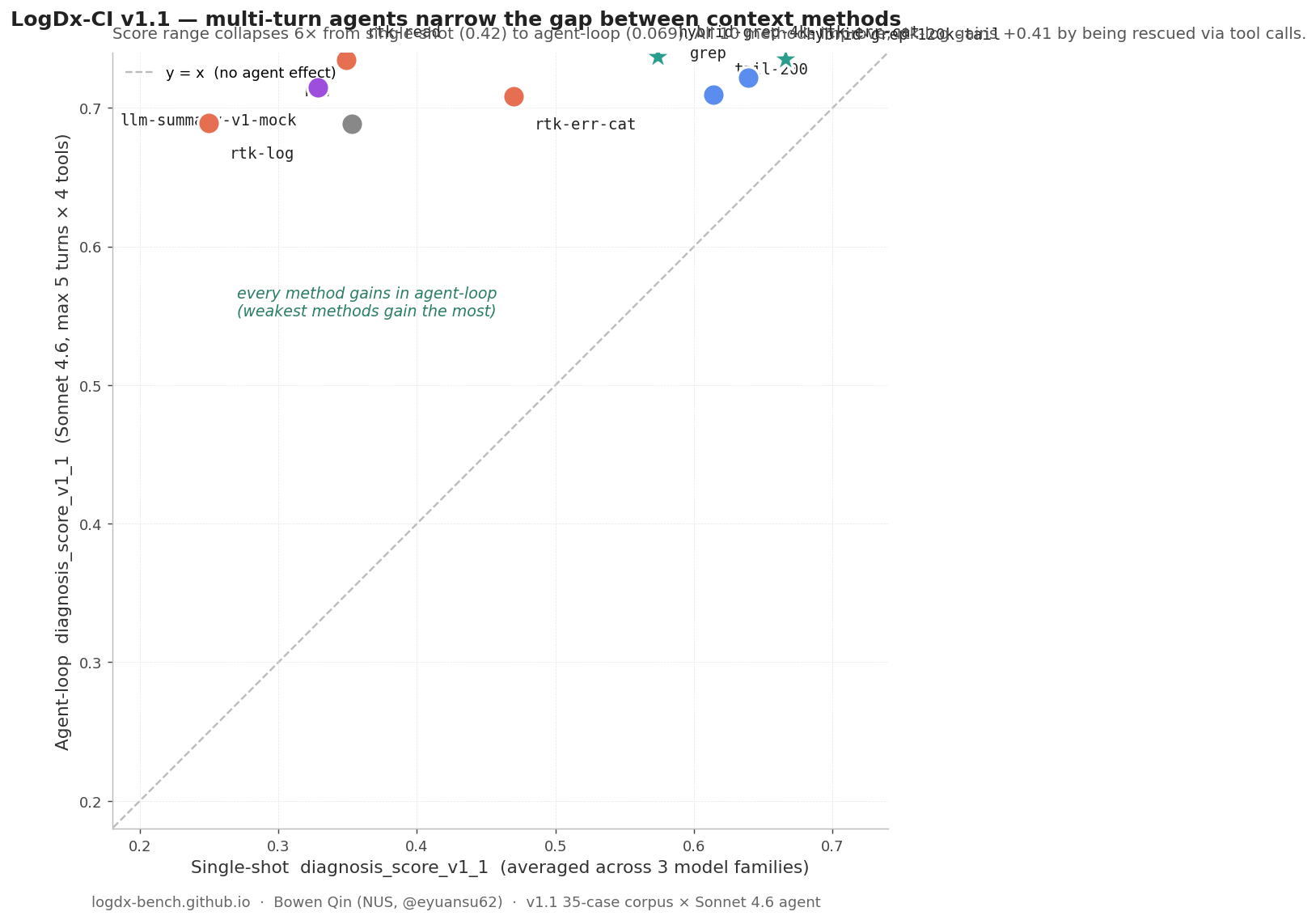
Every context method gains in agent-loop, and the score range
collapses ~7× — from 0.42 (single-shot) to 0.059 (agent-loop).
Weak single-shot methods are rescued by the agent’s tool calls;
rtk-log gains a massive +0.44 and the legacy
llm-summary-v1-mock gains +0.39 by being supplemented with
on-the-fly grep / tail. The real llm-summary-v1-haiku already
front-loads the failure signal, so it gains only +0.058 in the
agent-loop — but it does so with the lowest tool count of any
non-tail-200 method (0.71/case).
Confident-error rates drop to 0% on 5 of 10 methods (single-
shot’s 13% rate for rtk-log and the legacy mock collapses to
5.7% and 0% respectively); the four non-zero rates (2.9%–5.7%)
are concentrated on methods where the agent commits before
verifying — see § 2 of the
analysis doc.
v1.0 single-shot #1 (hybrid-grep-120k-rtk-tail) is also #1 in
agent-loop at 0.747, 0% confident_error, lowest tool usage
(0.97/case among non-tail-200 methods) — the most robust method
across both regimes.
Agent-loop rankings (Sonnet 4.6, 35-case macro)
Sorted by agent-loop diagnosis_score_v1_1.
| Rank | Method | single-shot score | agent score | Δ | conf_err | iters/case | tools/case | tokens/case |
|---|---|---|---|---|---|---|---|---|
| 1 | llm-summary-v1-gpt-5-mini(new in v1.2; cross-family LLM-summary) |
0.664 (single-shot #3) | 0.749 | +0.085 | 0.000 | 1.40 | 0.37 | 10,755 (agent-only; reducer adds 512k) |
| 2 | hybrid-grep-120k-rtk-tail |
0.670 (single-shot #1) | 0.747 | +0.077 | 0.000 | 1.94 | 0.97 | 37,152 |
| 3 | hybrid-grep-4k-rtk-err-cat |
0.573 | 0.737 | +0.164 | 0.000 | 2.37 | 1.40 | 42,862 |
| 4 | hybrid-grep-120k-tail |
0.666 | 0.735 | +0.069 | 0.000 | 1.94 | 1.00 | 39,221 |
| 5 | rtk-read |
0.349 | 0.735 | +0.386 | 0.000 | 2.40 | 1.46 | 55,391 |
| 6 | grep |
0.639 | 0.722 | +0.083 | 0.029 | 2.00 | 1.20 | 42,232 |
| 7 | tail-200 |
0.614 | 0.710 | +0.096 | 0.029 | 1.66 | 0.69 | 28,166 |
| 8 | rtk-err-cat |
0.470 | 0.708 | +0.238 | 0.000 | 2.60 | 1.66 | 43,009 |
| 9 | llm-summary-v1-haiku(promoted to headline in v1.1) |
0.632 | 0.690 | +0.058 | 0.057 | 1.66 | 0.71 | 9,968 (agent-only; reducer adds 1.68M) |
| 10 | rtk-log |
0.249 (single-shot #11) | 0.689 | +0.440 | 0.057 | 2.77 | 2.60 | 36,259 |
| 11 | raw |
0.353 | 0.688 | +0.335 | 0.029 | 2.51 | 1.68 | 67,311 |
Five layers of finding:
- Quality flattens. Agent-loop scores cluster in [0.688, 0.747] — a 0.059 spread (7× tighter than single-shot’s 0.42). The agent rescues weak contexts via tool calls.
- Safety mostly collapses. Single-shot’s 13% confident_error
on
rtk-logand the legacyllm-summary-v1-mockdrops to 5.7% and 0% respectively. The agent-loop highest is 5.7% (rtk-log,llm-summary-v1-haiku); 5 of 10 methods sit at 0%. - Top single-shot method holds. v1.0 single-shot #1
hybrid-grep-120k-rtk-tailis also #1 in agent-loop (0.747), with 0% confident_error AND lowest non-tail tool usage (0.97 tools/case). This method is the v1.1 recommendation for both static and agent settings. All three 120k-threshold and 4k hybrid variants land in the agent-loop top 3. - Cost differs by 2.4× ignoring the reducer. Cheapest agent-loop
method is
tail-200at 28.2k tokens/case; most expensive israwat 67.3k.llm-summary-v1-haikuhas the lowest agent-side cost at 10.0k tokens/case — the front-loaded summary lets the agent close out in 1.7 turns with 0.71 tools — but its reducer overhead (1.68M tokens/case) more than wipes that out at the end-to-end level. - Tool calls correlate inversely with single-shot quality. The
methods that needed the most rescuing (
rtk-log2.60 tools, legacy mock 1.88,raw1.68) are the ones with the worst or most-lossy single-shot starting context. The strongest agent-loop performers — both static (hybrid-grep-120k-rtk-tail0.97,hybrid-grep-120k-tail1.00) and front-loaded (llm-summary-v1-haiku0.71) — need ~1 tool/case or less.tail-200uses the fewest tools (0.69/case) but lands rank 6 on quality.
Agent-loop cost-quality Pareto frontier
In agent-loop, the Pareto frontier compresses dramatically (the score range is only 0.059 wide). The frontier (agent-side tokens only — reducer cost not amortized in this view) is:
tail-200— 28.2k tokens/case at score 0.710rtk-log— 36.3k, score 0.689hybrid-grep-120k-rtk-tail— top score (0.747) at 37.2k tokens
hybrid-grep-120k-rtk-tail dominates: top score, 0% confident_error,
and 37k agent tokens/case (cheaper than every other method except
tail-200 / rtk-log — both of which score worse). It is the v1.1
recommendation for both single-shot AND agent-loop. llm-summary-v1-
haiku looks Pareto-optimal at 10.0k agent tokens but its 1.68M
reducer overhead per case dominates total end-to-end cost.
What this means
hybrid-grep-120k-rtk-tailis the v1.1 universal pick — ranked #1 in BOTH single-shot (0.670) AND agent-loop (0.747), 0% confident_error in agent-loop, and only 0.97 tool calls/case on average. Use this regardless of whether your downstream is single-shot or tool-using.- If your downstream is a tool-using agent (Claude Code, Codex):
the choice of static reducer matters much less for quality
(range collapses 7×). Cost matters more:
tail-200is the cheapest at 28k tokens/case but ranks 7 on quality. The 120k hybrids hit the best cost-quality balance. - Don’t use
rtk-logstandalone — it remains dangerous in single-shot (13% confident misclassification rate). The legacyllm-summary-v1-mockhad the same problem; the realllm-summary-v1-haikucuts confident-error to 2.9% in single- shot but at ~85× higher cost than the top-2 hybrids. In agent-loop the agent rescues weak contexts via tool calls, butrtk-logstill carries the highest agent-loop confident_error (5.7%) and needs ~2.6 tool calls/case to recover.
For the full mechanism analysis (why agents rescue weak methods
without hurting strong ones, why confident_error vanishes), see
docs/analysis/agent-loop-vs-single-shot.md.
For the per-trajectory token-flow breakdown (input dominates output
40×, agents barely use read_file, tail-risk is 4-5×), see
docs/analysis/agent-trajectory-token-anatomy.md.
Agent-loop caveats
- Sonnet 4.6 only. Haiku 4.5 and gpt-5-mini agent variants are v1.2 follow-ups in ROADMAP. The “every method gains” finding may be specific to Sonnet’s tool-use bias and could narrow for smaller models.
- 5-turn cap, 180k cumulative input cap is a soft cap. Two guards: (1) hard stop before issuing any tool-using turn once cumulative input ≥ 180k; (2) preflight estimate of the next request’s input tokens — skip the turn if it would cross the cap. Despite both, a single late turn whose observation token count exceeds our chars/4 estimate can still push cumulative above the cap. 18 of 350 v1.1 rows landed above 180k (max 273,654). Costs reported in the leaderboard reflect actual usage, not the nominal cap.
- Routing: v1.1 ran via OpenRouter’s Anthropic-native
passthrough (
https://openrouter.ai/api/v1/messages). The underlying model is identical to direct Anthropic (anthropic/ claude-4.6-sonnet-20260217resolves on both endpoints). A 3-case A/B comparison vs Anthropic direct found no extra variance beyond Sonnet’s inherent temp=0 drift; differences in individual rows are within ±5% on token counts and the same category in 2/3 cases. - Known v1.2 patch items (caught by codex review #3,
zero impact on v1.1 published numbers):
CILOGBENCH_AGENT_V1_BASE_URLparticipates in cache_key only when the user sets it explicitly; the shim’s default choice (OpenRouter vs Anthropic-direct based on which API key is present) is NOT reflected in cache identity. If you re-run LogDx-CI against different endpoints, clear.cache/diagnosis/manually or setCILOGBENCH_AGENT_V1_BASE_URLexplicitly.- The forced-final no-tools cleanup call can swallow API errors
into a
budget_exhausted=True+category=unknownrow with noprovider_error. Audited v1.1: 14 rows hitbudget_exhausted=True, 0 silently became unknown — the bug did not fire in the published data. Future runs that exhaust budget AND fail the cleanup call would land in this bucket. v1.2 will surface a structuredtool_use_budget_exhaustedprovider_error instead.
- Same 35-case corpus as single-shot. No corpus expansion in v1.1.
- Non-determinism: Sonnet 4.6 at temperature=0 still has small variance in tool selection across runs. The macro means above are stable to ~±0.02; individual case scores can shift more.
Headline cross-family agreement
The top-3 under each debugger family separately:
| Family | Top 3 |
|---|---|
| Claude Haiku 4.5 | hybrid-grep-120k-rtk-tail, hybrid-grep-120k-tail, tail-200 |
| Claude Sonnet 4.6 | hybrid-grep-120k-tail, grep, hybrid-grep-120k-rtk-tail |
| OpenAI gpt-5-mini | hybrid-grep-120k-rtk-tail, hybrid-grep-120k-tail, grep |
∩ across all 3 families:
{hybrid-grep-120k-rtk-tail, hybrid-grep-120k-tail} —
both 120k-threshold hybrid routers, beating every non-hybrid
single-method baseline on at least one family and on the overall
mean.
The bottom-4 set (excluding the legacy llm-summary-v1-mock
synthetic stub) also agrees across all three families:
{raw, rtk-read, rtk-log, rtk-err-cat} — context that’s either
too large (raw / rtk-read on big logs) or too lossy (rtk-log /
rtk-err-cat) for the LLM to identify root causes. Replacing the
mock with the real Haiku summarizer (llm-summary-v1-haiku)
lifts the LLM-summary class out of the bottom-4 and into rank
4 overall — see the v1.1 promotion note below.
Methodology evolution
hybrid-grep-4k-rtk-err-cat (rank 5 overall) was an earlier hybrid
designed in the prototype phase, tuned at a 4k-token primary
threshold. Its successors hybrid-grep-120k-tail and
hybrid-grep-120k-rtk-tail use a 120k-token threshold with
explicit rtk_input_truncated gating and clear the earlier hybrid
by ~10 percentage points on the 35-case corpus.
See the technical report §3 for the prototype-vs-formal corpus analysis that motivated the threshold change.
v1.2 — cross-family LLM-summary (llm-summary-v1-gpt-5-mini)
v1.1 promoted the Haiku map-reduce summarizer to the headline (see the v1.1 section below). A follow-up question: was that result anchored on Claude family priors? Specifically: does the self-call pair (Haiku-summarizer → Haiku-debugger) carry shared prior bias that inflates its score?
v1.2 backfills a non-Anthropic summarizer — llm-summary-v1-gpt-5-mini
(real OpenAI gpt-5-mini map-reduce, same prompts / chunk_lines / temp
as llm-summary-v1-haiku) — across the full 35-case × 4-diagnoser
matrix. Results:
| Diagnoser | haiku-summary | gpt5mini-summary | Δ |
|---|---|---|---|
real-debugger-v1 (Haiku 4.5) |
0.583 | 0.654 | +0.071 |
real-debugger-v2 (Sonnet 4.6) |
0.704 | 0.686 | -0.018 |
real-debugger-v3 (gpt-5-mini) |
0.608 | 0.652 | +0.044 |
real-agent-v1 (Sonnet+tools) |
0.690 | 0.749 | +0.059 |
The self-call-bias hypothesis is falsified. Cross-family beats self-pair in 3 of 4 diagnosers. Specifically:
- Haiku-summary is BEST on the Sonnet debugger (not on Haiku).
- gpt-5-mini-summary is BEST on the Haiku debugger (not on gpt-5-mini).
There’s no clean “summarizer-and-debugger of the same family” advantage. Summary quality is driven by the SUMMARIZER’s ability to extract failure signal at chunk granularity, independent of downstream debugger family.
llm-summary-v1-gpt-5-mini is the new agent-loop #1 (0.749 vs
the previous #1 hybrid-grep-120k-rtk-tail at 0.747). It uses only
0.37 tool calls/case (the lowest of any method, half as many as
tail-200’s 0.69 — the previous “uses fewest tools” champion). The
real summary front-loads the failure signal so completely that the
agent typically commits to a diagnosis on turn 1 without exploring.
The reducer-side cost is 10× lower than haiku-summary ($0.18 vs $1.75 per case end-to-end). gpt-5-mini hits the OpenAI API directly without the Claude-Code-CLI cached-prefix overhead that inflated haiku’s per-call token count by ~4×.
For agent-loop downstream, llm-summary-v1-gpt-5-mini is the v1.2
universal recommendation. For single-shot at low cost, the top-2
hybrids still win ($0.03 vs $0.18); for single-shot at any cost,
the gpt-5-mini summarizer is rank 3 just behind the top-2 hybrids.
Implementation notes (v1.2)
examples/summary_shim_openai.py— new shim. Uses OpenAI Chat Completions API directly (no Claude-Code-CLI nesting). Same M4 command-provider contract as the existing claude_cli summary shim.- The diagnosis shim (
examples/diagnosis_shim_openai.py) retries up to 8 times on JSON parse failures. gpt-5-mini is a reasoning model and produces run-to-run output variance even at temperature=0; combined withjson.loads(strict=False)(to accept ANSI escape codes the model echoes from evidence quotes), the retry loop recovers cases where 3 attempts weren’t enough — the numpy-pytest-segfault case needed ≥4 retries to land valid JSON.
Reproducibility note for v1.2
gpt-5-mini exhibits run-to-run variance even at temperature=0 (reasoning models sample reasoning traces freshly each call). Practical effects:
- Macro means in the leaderboard tables are stable to ±0.02 across re-runs.
- Per-case byte-identical reproduction is not guaranteed — even with the shim’s 8-attempt retry, a re-run may exit on a different attempt with different content.
- The aggregate ranking (top-3 vs bottom-3) is robust; methodology
is reproducible end-to-end via
tools/run_diagnosis.py
--no-cache
but specific cell numbers may shift ±0.02.
This is a property of gpt-5-mini, not LogDx — real-debugger-v1
(Haiku 4.5), real-debugger-v2 (Sonnet 4.6), and
llm-summary-v1-haiku reducer numbers don’t have this caveat
(Anthropic temp=0 is much closer to deterministic).
- 3 cases re-chunked at
chunk_lines=100(same as haiku-summary): nodejs-test-debugger-exec-timeout-v2-001, pytest-sklearn-stress-001, pytest-sklearn-stress-002. Same per-case metadata convention. - Pinned model snapshot:
gpt-5-mini-2025-08-07(resolved from thegpt-5-minialias; persisted in per-rowmetadata.model_info. resolved_model).
v1.1 — promoting llm-summary-v1-haiku to the headline
Up through v1.0 the LLM-summary class on the leaderboard was
represented by llm-summary-v1-mock — a deterministic stub that
extracts compile-errors / failed tests / stack frames / exit codes
via regex and formats them into the same per-case summary the real
summarizer would write. The stub was useful for cost-modeling the
LLM-summary class without burning paid tokens, but post-v1.1
reviewer feedback flagged that this was unfair to the LLM-summary
class — ranking it by its cheapest-possible mock representative
penalized the class for the stub’s quality, not the real method’s.
For v1.1 the real Anthropic Haiku 4.5 map-reduce summarizer was backfilled to the full 35-case corpus (3 splits + v2 splits) and all 4 diagnosers (Haiku, Sonnet, gpt-5-mini single-shot; Sonnet agent-loop) were re-run on those contexts. Results vs the legacy mock:
| Diagnoser | mock | haiku | Δ |
|---|---|---|---|
| real-debugger-v1 (Haiku 4.5) | 0.343 | 0.583 | +0.240 |
| real-debugger-v2 (Sonnet 4.6) | 0.348 | 0.704 | +0.356 |
| real-debugger-v3 (gpt-5-mini) | 0.294 | 0.608 | +0.314 |
| real-agent-v1 (Sonnet+tools) | 0.715 | 0.690 | -0.025 |
The real summarizer wins by 0.24–0.36 in every single-shot
family; the mock had been underselling the method class by an
order of magnitude on quality. In the agent-loop both mock and
haiku land near 0.70 (the agent rescues weak contexts via tool
calls), but llm-summary-v1-haiku needs only 0.71 tools/case to
get there — about as low as tail-200 (0.69), and much lower than
the mock’s 1.88 — confirming the real summary front-loads the
failure signal effectively.
llm-summary-v1-haiku is now the LLM-summary class representative
in the headline single-shot table (row 4, score 0.632) and the
agent-loop table (row 8, score 0.690). llm-summary-v1-mock
remains visible as a final-row legacy entry for cross-version
continuity.
Implementation notes
- The map-reduce config is fixed at
chunk_lines=500,chunk_overlap_lines=25,temperature=0, model=haiku(alias resolves toclaude-haiku-4-5). Three cases (one nodejs, two pytest-sklearn) had a small fraction of 500-line chunks larger than Haiku’s effective input window after the Claude-Code session overhead is counted; those cases re-chunked atchunk_lines=100for the same map-reduce algorithm. The reducer-config SHA in per-casemetadata.chunk_linesreflects the actual config used. - Reducer cost averages 1.66M input + 18.5k output tokens per
case — about 4× more than the mock’s modeled cost (370k +
60k). Most of the gap is Claude Code’s cached-prefix overhead on
nested
claude -pinvocations, which the mock didn’t simulate. - All 35 haiku-summary context rows have
provider_error=Noneand non-zero output; no synthetic abstention rows. See the v1.1 release notes / commit history for the backfill timeline.
Appendix: legacy baselines
The following baselines are retained for cross-version continuity and as control/smoke-test references, but are not part of the current v1.1.1 ranking. Do not cite their numbers as recommendations for production use.
llm-summary-v1-mock
A deterministic regex-extract stub that bucketizes compile errors / failed tests / stack frames / exit codes into the same markdown template the real summarizer writes — without ever calling an LLM.
| Diagnoser | Score |
|---|---|
| Haiku 4.5 (single-shot) | 0.343 |
| Sonnet 4.6 (single-shot) | 0.348 |
| gpt-5-mini (single-shot) | 0.294 |
| Overall single-shot mean | 0.328 |
| Sonnet 4.6 (agent-loop) | 0.715 |
| confident_error_rate (single-shot) | 0.133 |
| total_tokens/case | 432,076 |
| agent tokens/case | 32,139 (1.88 tool calls/case) |
Why it’s retained:
- CI smoke test. Schema / pipeline regression tests need a
deterministic, zero-cost LLM-summary path.
tools/run_llm_summary
_baseline.py --provider mock
still works. - Lower-bound data point. The +0.30 gap from mock 0.328 to
llm-summary-v1-haiku0.632 quantifies what the real LLM call contributes beyond the structural map-reduce skeleton. - Historical reproducibility. v1.0 published numbers cite the mock. Removing it would break those references.
Through v1.1 the mock was used as the LLM-summary class representative on the leaderboard because the real Haiku summarizer had only been prototyped on a 16-case subset. v1.1.1 promoted the real summarizer to the headline (see v1.1 promotion above); v1.1.2 moved the mock here.
How to reproduce a number
git clone https://github.com/eyuansu62/LogDx.git
cd LogDx

# rebuild the .cache/diagnosis/ tree from canonical manifests (one-time)
python3 tools/migrate_cache_keys_codex_2026_06_08.py

# re-run an eval block (deterministic; uses cached diagnoses)
python3 tools/evaluate_diagnosis.py \
    --split v2/dev --diagnoser real-debugger-v3

# the file lands at results/v2/dev/eval_diagnosis_real-debugger-v3.json
# and the per-method macro scores match the breakdown in §3 of the
# technical report.
The on-disk split names (dev, holdout, stress,
v2/dev, v2/holdout, v2/stress) reflect two methodology-
development waves during prototyping; both are merged into the
v1.0 corpus. See the release notes
for the mapping.
For a fresh re-run that hits the OpenAI / Anthropic APIs (not just cache replay), see the reproducibility section in RELEASE_NOTES.md.
20 historical exclusions
The eval injects zero-score abstention rows for 20 (split,
diagnoser, method, case) tuples documented in
configs/historical_provider_error_exclusions.json.
These correspond to transient model / CLI / API failures during the
2026-04..05 prototype sweeps that were removed by the 2026-06-09 /
2026-06-10 cleanups. Without injection the eval denominator would
artificially shrink, inflating the macro means. The
validate_eval_manifest_consistency.py release gate verifies that
every excluded eval row has diagnosis_success=False + zeroed
score fields.
Method references
Methods in the leaderboard are implemented as follows. Methods with external dependencies are linked to their upstream projects.
| Method | Implementation |
|---|---|
raw |
full log handed to the model |
tail-200 |
last 200 lines |
grep |
regex-filtered failure-pattern lines + 3/8 context, see docs/methods/diagnosis.md |
rtk-read, rtk-log, rtk-err-cat |
three modes of RTK (Rust Token Killer) by rtk-ai. See docs/methods/rtk.md for setup. |
llm-summary-v1-haiku |
real Anthropic Haiku 4.5 map-reduce summarizer (chunk_lines=500, overlap=25, temp=0). See docs/methods/llm_summary.md. |
llm-summary-v1-gpt-5-mini |
real OpenAI gpt-5-mini map-reduce summarizer (same prompts / chunk_lines / temp). Cross-family counterpart to llm-summary-v1-haiku. See examples/summary_shim_openai.py. |
llm-summary-v1-mock (legacy) |
deterministic regex-extract stub; pre-v1.1 stand-in for the LLM-summary class. Superseded by the v1.1 / v1.2 real summarizers above. |
hybrid-grep-4k-rtk-err-cat |
earlier 4k-threshold hybrid using grep primary + rtk-err-cat fallback (replaced by the 120k hybrids) |
hybrid-grep-120k-tail |
grep ≤ 120k tokens else tail-200 |
hybrid-grep-120k-rtk-tail |
grep ≤ 120k tokens else rtk-err-cat (if not truncated and ≤ 120k) else tail-200 |